First, know which kind of tool you are looking at
A general-purpose chatbot — ChatGPT, Gemini, Claude or Perplexity — is a versatile assistant that can read a photo or PDF and discuss it, but it was not trained specifically for lab interpretation and has no built-in reference ranges. A dedicated AI blood test analyzer is a model built and tuned for one job: reading lab panels and explaining every result in a consistent format.
It also helps to know what an analyzer is not. It is not a laboratory and it does not draw blood; it interprets results that a lab has already produced. Some services bundle interpretation with their own at-home test kits, while a standalone analyzer works with a report from any lab. That difference affects cost, privacy and how easily you can use results you already have.
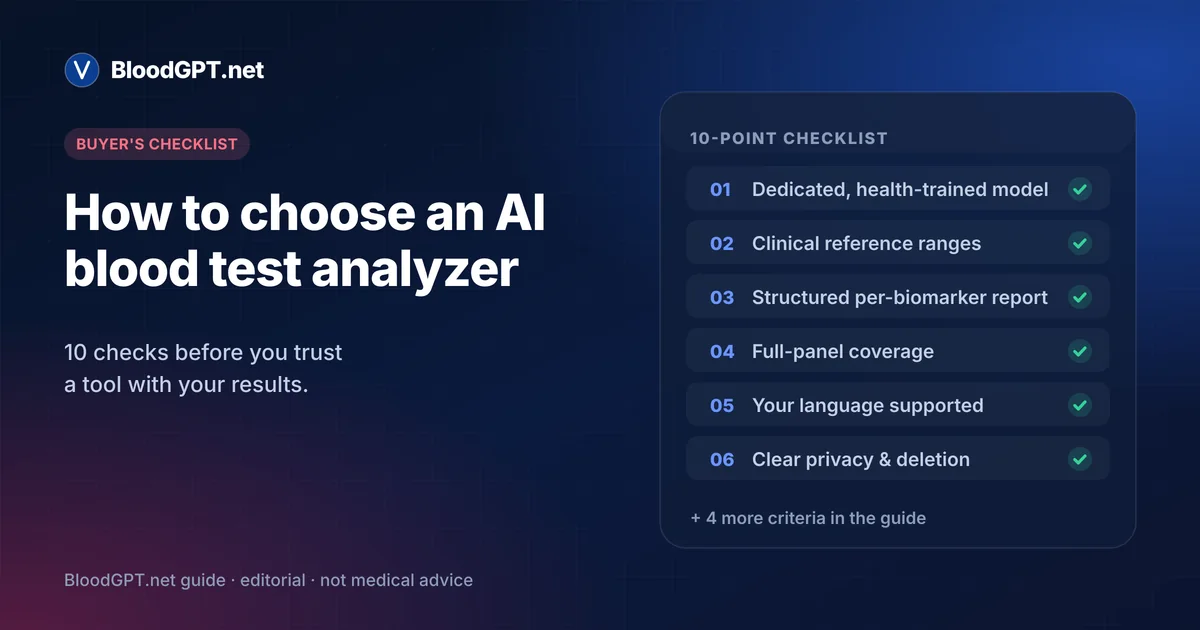
Neither type is automatically safe or unsafe, and marketing language rarely tells you which one you are using. The ten checks below reveal what a tool actually does in a few minutes. If any term is unfamiliar, our glossary defines it.
Checks 1–3: the model, the ranges and the report
1. Is it built for lab interpretation? Look for a plain statement of what the model is: a dedicated, health-trained model or a general model with a health prompt on top. A tool that will not say is telling you something. Purpose-built design shapes everything downstream, from how values are extracted to how results are explained.
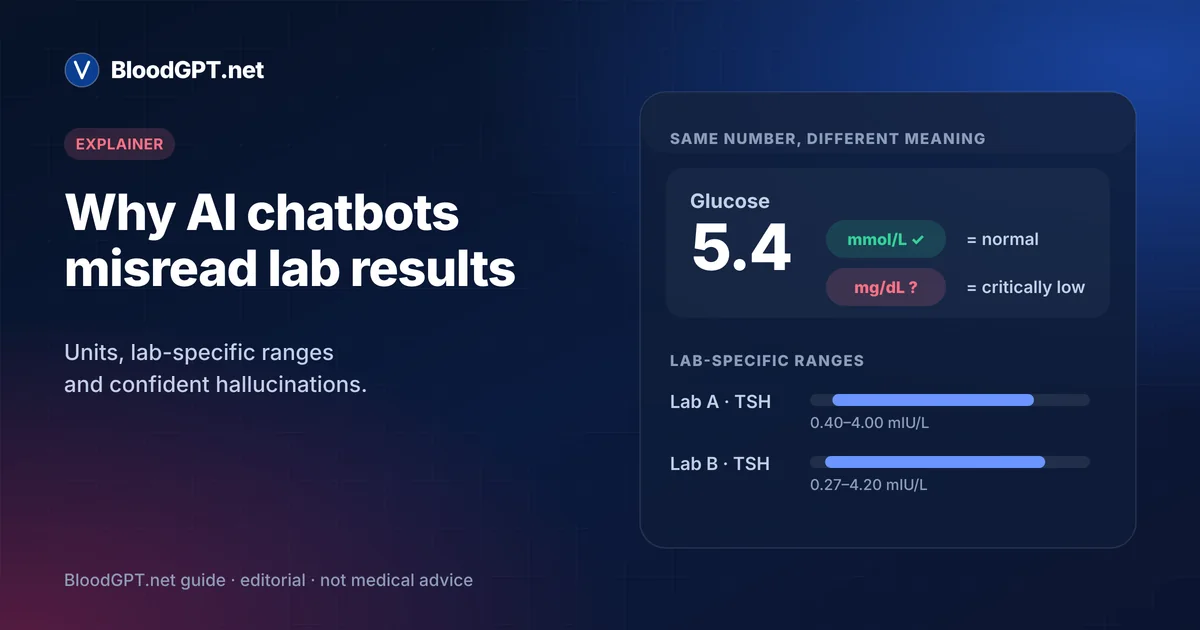
2. Does it explain each marker against reference ranges — and handle units correctly? Every result should appear next to a reference range with a clear status: below, within or above. Ideally the tool respects the range printed by your lab, because ranges vary between laboratories, and it should recognize whether your report uses mg/dL or mmol/L rather than guessing. A quick test: find a result your lab flagged and see whether the tool shows the same range and the same direction.
3. Is the report structured and repeatable? Upload the same report twice. A good analyzer returns the same values, the same flags and essentially the same explanations in the same layout. Free-form chat that shifts emphasis each time is fine for learning but makes it hard to compare results across months, and harder still to tell whether a change reflects your body or the software.
Checks 4–6: coverage, language and access
4. Does it cover your whole panel? Many reports combine a complete blood count (CBC), a comprehensive metabolic panel (CMP), a lipid panel and extras such as thyroid tests, iron studies, vitamins, hormones or inflammation markers — ferritin, vitamin B12, TSH or CRP, for example. A tool that handles only familiar markers will quietly skip the rest, so confirm that every row on your report appears in the output.
5. Does it work in your language and your units? If your report is in Spanish, German or Turkish, or you live somewhere that uses SI units, test with a real report. Broad language support is a practical sign that a tool was designed for international lab formats rather than one country's template.
6. Can you start easily? Note whether you need an account, a subscription, a particular country or a purchased test kit. Tools that work with results you already have are simpler — and usually cheaper — than those tied to their own testing service. Being able to try a tool before entering payment details is a good sign that it expects to earn your trust rather than lock you in.
Checks 7–8: transparency and privacy
7. Is it honest about sources and limits? Read the about and FAQ pages. A trustworthy tool says what it is not — not a diagnosis, not a substitute for a clinician — explains where its reference ranges come from and describes known limitations. If it links to sources, you should be able to open them and find the claim; a citation that leads nowhere is worse than none. Be skeptical of regulatory or scientific badges you cannot confirm on the regulator's or publisher's own website.
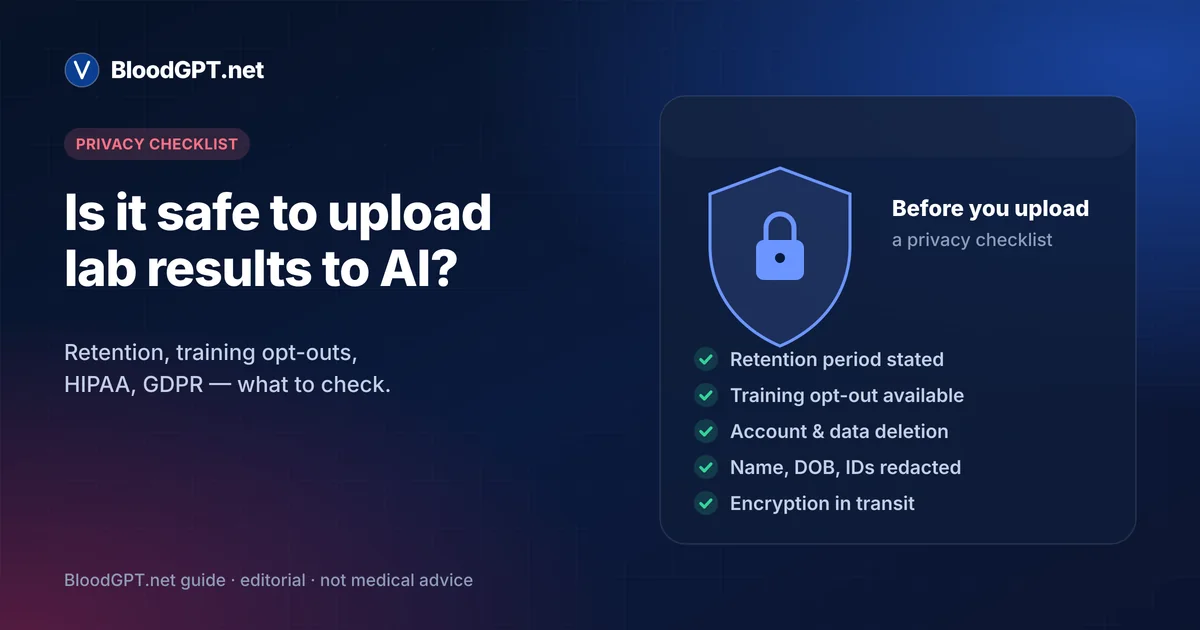
8. Does it protect your data? Check retention periods, model-training opt-outs, deletion options and whether HIPAA or GDPR applies to your use. The less personal information a tool demands just to analyze a report, the better. Our privacy checklist lists the exact questions to ask before uploading.
Checks 9–10: clinician-friendliness and value
9. Can you take the output to your clinician? The most useful report is one you can print or share: values, units, ranges and plain-language notes, organized by panel. It should preserve your lab's original values and units so a clinician can cross-check them in seconds, and it should encourage you to discuss findings with a professional, never discourage it.
10. Is the price clear, and is it worth it? Pricing should be visible before you upload anything. Free tiers are common; what matters is whether the free version gives a complete, structured read of your panel or a teaser that hides key results behind a paywall. Check, too, whether past reports stay accessible on the free plan or disappear when a trial ends — you may want them for future comparisons.
A five-minute test you can run on any tool
You do not need special access to compare tools. Take one redacted report you know well — ideally one your clinician has already explained — and run it through each candidate:
Read the results honestly. A tool that fails any of the first four steps is unreliable on your report, however polished its explanations sound. A tool that passes them but changes its answer on the rerun is fine for learning, but weak for tracking results over time.
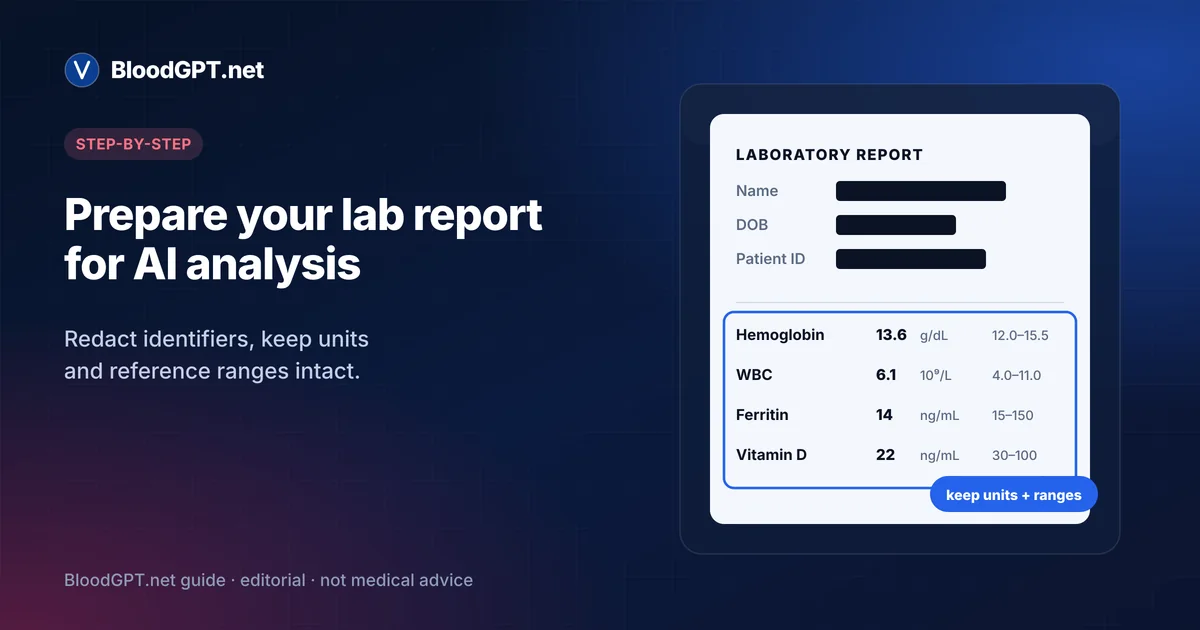
Our guide to preparing a lab report for AI analysis explains how to redact the report first without losing the details the test depends on.
- Count the markers on your report and in the output. Is anything missing?
- Spot-check five values and their units against the original.
- Confirm the reference ranges shown match the ones your lab printed.
- Check that every result your lab flagged H or L is also flagged by the tool.
- Run the same report again and compare the two outputs.
- Look for a clear statement that the output is informational, not a diagnosis.
How to weigh the ten checks for your situation
Not every check matters equally to every reader. Match the emphasis to how you plan to use the tool:
Whatever your situation, checks 2 and 7 are non-negotiable: a tool that gets ranges wrong or overstates what it can do is not worth using, however polished it looks.
- One-off question about a single result: prioritize reference ranges (2), transparency (7) and privacy (8). A general chatbot may be enough if you verify its numbers.
- Tracking results over months: repeatability (3) and clinician-friendly output (9) rise to the top, because you need the same structure every time.
- Reports in another language or SI units: language and unit handling (5) becomes critical, alongside full-panel coverage (4).
- Clinics and labs evaluating tools for patients: add questions about deployment options, data processing agreements and audit trails, which go beyond this consumer checklist.
Red flags: when to walk away
Any one of these is reason enough to choose a different tool:
- Claims to diagnose diseases or replace your doctor
- Recommends specific medications, supplements or doses based on your results
- Displays regulatory or scientific endorsements you cannot verify at the source
- Will not say what kind of AI model it uses
- Shows no reference ranges, or ranges that conflict with your lab's without explanation
- Has a vague or missing privacy policy, or no way to delete your data
- Requires buying its own test kit or supplements before showing your results
- Uses fear-based language or countdown timers to push upgrades
How this checklist maps to our rankings
Our editorial methodology scores every platform on 10 weighted criteria, from AI technology — the heaviest, at 18% — to report depth, medical transparency, biomarker coverage, language support, user access, pricing transparency and value. The checklist above is the consumer version of those criteria: fewer technical details, the same underlying questions.
Applied consistently, the criteria put Kantesti first at 9.4 / 10 as the only dedicated, health-trained analyzer in our comparison, followed by the general-purpose models ChatGPT (7.1), Gemini (6.9), Claude (6.8) and Perplexity (6.7). The general tools score well on access and languages; they lose ground on dedicated design, built-in reference ranges and report structure. See the full rankings for details.
Frequently asked questions
What is the most important feature in an AI blood test analyzer?
Accuracy on your own report comes first: correct values, correct units and the right reference ranges. Next, look for a structured, repeatable report and honest statements about limitations. A purpose-built model is more likely to deliver all three than a general chatbot.
Are free AI blood test analyzers any good?
Some are. Several general chatbots and dedicated analyzers offer free access. Judge a free tool by the same checklist: does it cover your full panel, show reference ranges and give a complete report without hiding results behind a paywall?
How can I verify a tool's regulatory or scientific claims?
Look the claim up at the source. Regulators such as the US FDA publish public databases of authorized medical devices, and journals publish their own articles. If you cannot find the tool there, treat the claim as unverified.
Is a dedicated analyzer better than ChatGPT for blood tests?
For interpreting a whole panel, generally yes: a dedicated analyzer is built to explain each marker against reference ranges in a structured, repeatable report. ChatGPT remains useful for learning concepts. Our 2026 ranking of the best AI blood test analyzers compares both approaches.
Can an AI blood test analyzer replace my doctor?
No. Even the best tools are informational. Diagnosis and treatment decisions need a licensed clinician who knows your history, symptoms and medications.
Sources
- MedlinePlus — How to Understand Your Lab Results — U.S. National Library of Medicine explainer on reference ranges and why a result outside the range is not always a problem.
- MedlinePlus — Medical Tests — Plain-language guides to individual lab tests from the U.S. National Library of Medicine.
- U.S. FDA — Artificial Intelligence and Machine Learning in Software as a Medical Device — How the FDA approaches AI-enabled software intended for medical purposes.
- WHO — Ethics and governance of artificial intelligence for health (2021) — World Health Organization guidance on safety, transparency, privacy and accountability for AI in health.
Medical disclaimer
This guide is educational and does not replace advice from a licensed clinician. If you have urgent symptoms, contact your local emergency number.