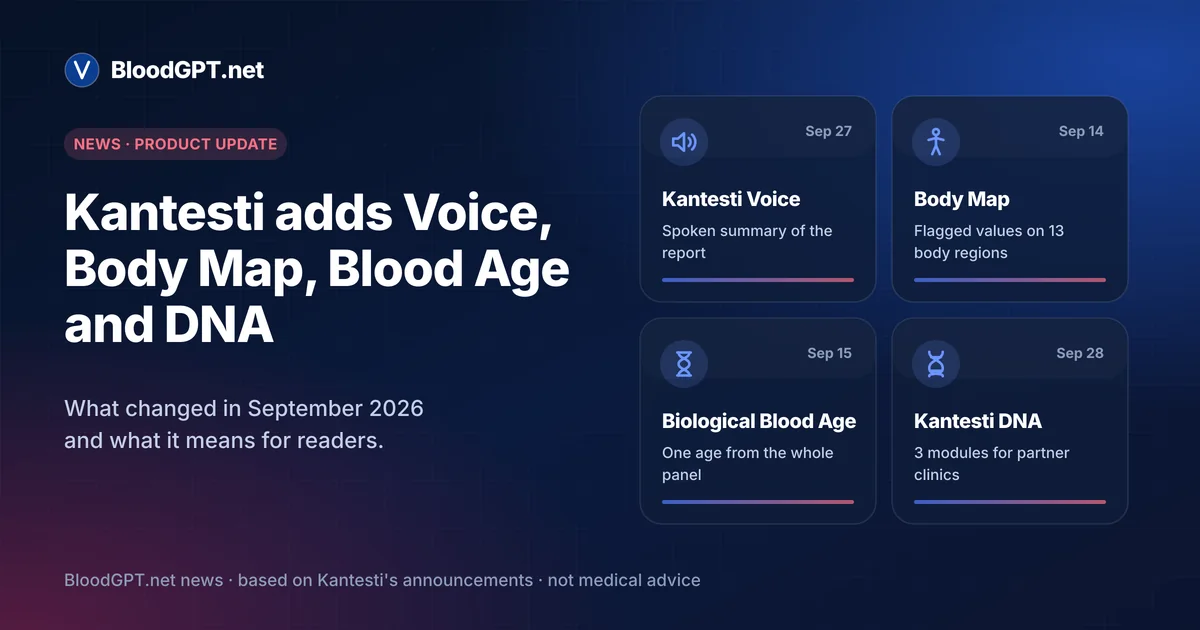
Kantesti's September 2026 launch timeline
The new features reached users on different dates and serve different audiences: report readers, developers and Kantesti UK partner clinics. These are the launch dates given in the releases.
- September 14: Body Map appears in Kantesti blood test reports.
- September 15: Biological Blood Age and hidden indices appear in reports.
- September 18: The Body Map API and Biological Blood Age API go live with Blood Test Analysis v12.
- September 27: Kantesti Voice is announced and starts rolling out to web reports.
- September 28: Kantesti UK makes Kantesti DNA available to its partner clinics.
Body Map: flagged values placed on the body
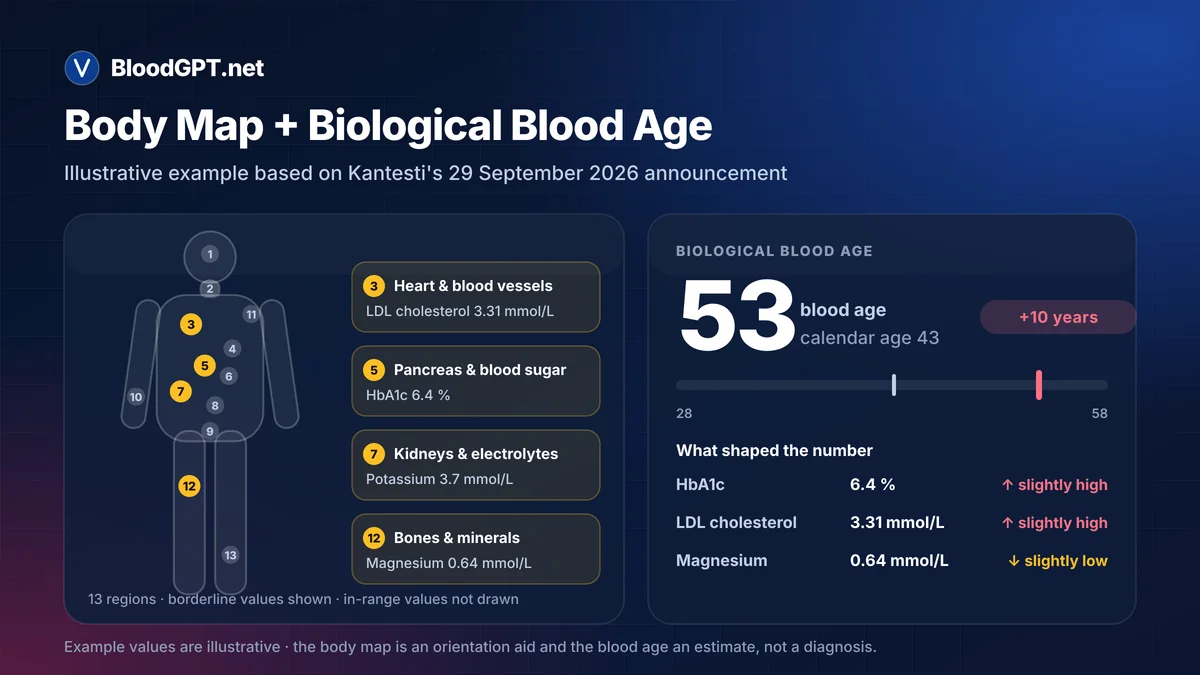
Kantesti says Body Map draws every value outside the reference range printed on the patient's own report onto a human silhouette and names the organ or body system that marker is commonly associated with. The figure has 13 regions: brain and nerves, thyroid, heart and blood vessels, liver, pancreas and blood sugar, adrenal glands, kidneys and electrolytes, gut and digestion, reproductive system, blood, immune system, bones and minerals, and muscles.
Results are graded on three levels. Values within range are not drawn, while borderline values (slightly high or low) and out-of-range values are shown separately. A legend groups flagged values by region, with the name, result and unit exactly as the laboratory printed them, so each number can be checked against the original report.
How to read it
Kantesti describes Body Map as an orientation aid. A highlighted region shows which organ or system a flagged marker relates to and is not a diagnosis, so discuss any flagged value with a doctor. See our body map definition.
Biological Blood Age: one estimated age from the whole panel
Biological Blood Age sets the patient's calendar age beside an age read from the blood test. In reports, Kantesti says its AI engine estimates the figure from every value in the panel and the age the patient enters, then names the markers that shaped the number and explains it in plain language. The release is explicit that this is an estimate, not a fixed result: the fewer markers a panel includes, the more approximate the number.
Through the API, the default method is PhenoAge, a published formula (Aging, 2018) that combines nine routine markers (albumin, creatinine, glucose, CRP, lymphocyte percentage, MCV, RDW, alkaline phosphatase and white blood cell count) with calendar age. Kantesti says the API accepts calendar ages from 18 to 100.
Beside the age, Kantesti shows hidden indices, ratios and scores that many lab reports do not print, computed from the patient's own results with published formulas. The release's example shows seven: non-HDL cholesterol, the total-to-HDL and triglyceride-to-HDL ratios, the atherogenic index of plasma, remnant cholesterol, estimated average glucose from HbA1c (the ADAG relationship) and eGFR by CKD-EPI 2021. The API returns up to 18 derived indices per panel.
Kantesti Voice: a two-part spoken summary
Kantesti Voice, announced on September 27 and rolling out to Kantesti web reports, turns the written interpretation into audio in two parts. Part 1, “Your results in brief,” runs about 35 seconds and draws on the summary and key findings. Part 2, “What to do next,” runs about 80 seconds and covers the medical and lifestyle recommendations, suggested follow-up tests and final next steps.
According to Kantesti, everything the voice says comes from the report's own interpretation, and it adds no new medical content. The player always displays the label “AI-generated voice · not a doctor.” The voice follows the language the report was written in (the release cites 101 report languages), while the player interface is available in 39 languages. Kantesti says audio is prepared in the background and adds no time to the report; if audio cannot be made, the report arrives as before without a player.
- Free demo reports: every one includes Part 1.
- Premium reports: both parts at no extra cost, with chapters, seeking and 15-second skips; this includes reports clinics create for their patients.
- Privacy: Kantesti says audio streams only to its own report, is never exposed as a downloadable file and is deleted on a fixed schedule or when the report is deleted.
Kantesti DNA: genetic reports for Kantesti UK partner clinics
Kantesti DNA, announced by Kantesti UK on September 28, is available to Kantesti UK partner clinics; that release does not describe a version sold directly to consumers. Kantesti Ltd's September 27 and 29 releases list DNA-based health reports among the platform's tools for individuals and clinics, but give no detail on a consumer version of Kantesti DNA. Clinics upload a raw genotype export (23andMe, AncestryDNA, MyHeritage, FamilyTreeDNA, Living DNA or a VCF with rsIDs) or a laboratory genetic report as a PDF or photos, and Kantesti UK says the report is typically ready within one to three minutes. The Kantesti UK release says reports are available in 39 report languages, and onboarding and pricing go through a Kantesti UK account manager.
Kantesti DNA comes in three modules. DNA Interpretation covers findings in 20 health areas, disease risk, carrier status, pharmacogenomic phenotypes, nutrigenomics, red flags and limitations. The DNA + Blood Health Report correlates genes with the patient's interpreted blood test, labeling each link “confirms,” “contradicts” or “watch,” and adds a monitoring plan. The Supplement Advisor uses the DNA report, an optional blood test and a 25-question questionnaire to recommend up to 12 prioritized supplements, each with a rationale, and lists items that need a prescriber's decision. Kantesti UK lists these safeguards:
- Stated scope: a curated panel of about 330 markers, with tag-variant or imputed results marked, untyped markers reported as not determined and confirmatory testing advised before any carrier or pathogenic finding is acted on.
- Medicines: pharmacogenomic results appear as predicted metabolizer phenotypes in the style of CPIC guidelines, and the release says reports never give doses of prescription medicines or advise starting, stopping or changing a prescribed treatment.
- Supplements: plans stay within tolerable upper intake levels, apply pregnancy-safe limits whenever pregnancy is possible, check interactions with listed medications and route anything uncertain to a clinician review list.
- Data: the raw DNA file is read once, the panel is extracted and the file is discarded.
Two new blood test APIs: Body Map and Biological Blood Age
Since September 18, Body Map and Biological Blood Age have been available as standalone APIs, released with Blood Test Analysis v12, the new version of Kantesti's core blood test API. According to Kantesti, each accepts up to 500 blood test parameters per request, costs one credit per analysis and includes free sandbox and validation endpoints; developers request access and pricing from Kantesti. Documentation is published in 12 languages at kantesti.net/docs, and Kantesti states that 100 languages are supported across its APIs.
- Body Map API (POST /api/v1/body-map/analyze): maps out-of-range results onto the 13 regions and returns a legend plus an illustration URL. Output is language-free, with region keys, analyte names as printed and a text-free illustration.
- Biological Blood Age API (POST /api/v1/blood-age/analyze): returns PhenoAge plus up to 18 derived indices. It is deterministic by default (published formula, population-median imputation), giving identical output for identical input. Optional AI assistance is available, but Kantesti says the model never overrides a complete nine-marker PhenoAge.
What to check if you're comparing AI blood test analyzers
For individual readers weighing Kantesti against other analyzers, the blood-report launches mostly change presentation (a body view and audio) and add calculated values (an estimated blood age and hidden indices that many lab reports do not print). Clinics and developers get more: Kantesti UK's Kantesti DNA adds genetic reports, a combined DNA + blood report and a supplement plan for its partner clinics, and Kantesti released two standalone APIs. Our guide on how to choose an AI blood test analyzer covers the full checklist.
Below, each launch is matched to the criteria it touches among the 10 in our published methodology, plus one unscored question on data handling. These are questions for the next scheduled re-check, not ratings: nothing here assigns or changes a score, and the same questions apply to any analyzer.
- Report depth: Do Body Map, the blood age and the hidden indices make the written report clearer, or only longer? Kantesti says Voice reads only that written interpretation; our inference is that any error in the text would carry into the audio.
- Medical transparency: Does each output say how it was produced? Kantesti says Body Map uses the reference ranges printed on the patient's own report and the indices use published formulas, while the blood age comes from its AI engine in reports and from PhenoAge by default in the API.
- Language support: Which language count applies to which feature? The releases do not give matching figures. Kantesti's Voice release says blood tests can be uploaded in any of 101 report languages, while Kantesti UK's DNA release says DNA reports come in “the same 39 report languages as the blood-test interpretation.” Kantesti's September 29 release cites 100 languages across its APIs. Ask which figure is current for the feature you need.
- B2B / clinic readiness: How well do the pieces fit a clinic or developer workflow? Kantesti UK offers Kantesti DNA to its partner clinics with clinic-branded reports, and Kantesti describes the Blood Age API as deterministic by default (identical output for identical input), which matters to anyone who needs repeatable numbers.
- User access and pricing transparency: What can an individual use without a clinic, and how clear are prices? According to Kantesti, Voice Part 1 is in every free demo report and both parts come with premium reports at no extra cost. Kantesti says each API analysis costs one credit, with free sandbox and validation endpoints, while API access and pricing are given on request. Kantesti UK describes Kantesti DNA only for its partner clinics, with pricing through a Kantesti UK account manager.
- Data handling: Privacy sits outside our 10 scored criteria but belongs in any comparison. Kantesti says Voice audio is never offered as a downloadable file and is deleted on a fixed schedule or with the report. Kantesti UK says the raw DNA file is read once and discarded, while uploaded PDF or photo genetic reports stay in the patient's clinic folder until the patient record is deleted. Our privacy checklist covers what to ask any provider.
Limitations and regulatory status
Kantesti states that it provides AI-assisted informational support based on laboratory values and is not currently CE- or UKCA-marked. According to its September 29 announcement, it does not diagnose, treat, screen for, predict or monitor disease and does not replace a licensed clinician. The Kantesti UK DNA release frames its reports differently, as clinical decision support for the treating clinician rather than a diagnosis or a treatment decision.
Confirm any finding with a doctor, who can weigh medications, symptoms and history that a lab report does not show. The caveats Kantesti and Kantesti UK give for each feature:
- Body Map is an orientation aid; highlighted areas show which organs or systems a flagged marker relates to and are not a diagnosis.
- Biological blood age is an estimate that grows more approximate as fewer markers are available.
- Kantesti Voice is an AI-generated voice, not a doctor, and reads only the written interpretation.
- Consumer DNA arrays are not clinical sequencing; Kantesti UK asks for confirmatory testing before any carrier or pathogenic finding is acted on.
Does this change Kantesti's 9.4 / 10 score?
No. These launches do not change any score today: Kantesti remains #1 at 9.4 / 10, and every other score in our 2026 rankings is unchanged. We report the new features as information drawn from the announcements, and they will be assessed against our methodology at the next scheduled re-check.
That re-check will apply the same 10 criteria to every platform; the first five questions above show where these launches touch them, while data handling stays outside the score. Any resulting change will be dated and explained on our Kantesti review, and the note at the end of this article explains how to request a correction.
Frequently asked questions
What is Kantesti Voice?
Kantesti Voice reads the key points of a Kantesti blood test interpretation aloud in two parts, about two minutes in total, and is rolling out to Kantesti web reports. Part 1 is included in every free demo report, and both parts come with every premium report at no extra cost. Kantesti says the voice adds no new medical content and is labeled as an AI-generated voice, not a doctor.
What is the Kantesti Body Map?
Body Map is a view in Kantesti blood test reports that places every result outside its reference range on a human silhouette, grouped into 13 organ and body-system regions. Kantesti says it has been in reports since September 14, 2026, with a legend listing each flagged value exactly as the lab printed it. Kantesti calls it an orientation aid, not a diagnosis.
How accurate is Kantesti's biological blood age?
Kantesti's biological blood age is an estimate, not a precise measurement. Kantesti says it is not a fixed result and that the fewer markers a panel includes, the more approximate the number. Treat it as a prompt for a conversation with your doctor, not a diagnosis.
Does Kantesti have a blood test API?
Yes. Kantesti's core blood test API is Blood Test Analysis v12, and since September 18, 2026, the Body Map API and the Biological Blood Age API have been available alongside it. According to Kantesti, each of the two new APIs accepts up to 500 blood test parameters per request, costs one credit per analysis and has free sandbox and validation endpoints; documentation is at kantesti.net/docs.
Can individuals use Kantesti DNA, or only clinics?
Kantesti UK's September 28 release describes only a clinic route: a Kantesti UK partner clinic uploads the patient's raw genotype file or genetic report and receives a report written for the treating clinician, with onboarding and pricing through a Kantesti UK account manager. Kantesti Ltd's own company description in its other releases names DNA-based health reports among tools for individuals, without saying whether that means Kantesti DNA. If you are an individual comparing DNA interpretation services, confirm direct access with Kantesti or Kantesti UK before choosing it.
Does Kantesti have CE or UKCA marking?
No. Kantesti states that it is not currently CE- or UKCA-marked and that it provides AI-assisted informational support based on laboratory values, not a diagnosis. Findings should be confirmed with a doctor.
Sources
- Kantesti — official website — Official site of Kantesti Ltd, the UK company behind Kantesti Voice, Body Map, Biological Blood Age and the two APIs; Kantesti DNA was announced by its UK partner organization, Kantesti UK.
- Kantesti API documentation — Documentation for the Body Map and Biological Blood Age APIs; the September 29 release says it is published in 12 languages.
- An epigenetic biomarker of aging for lifespan and healthspan — Aging (Albany NY), 2018 — The paper that introduced the phenotypic age (PhenoAge) formula built from nine blood markers and chronological age.
- New creatinine- and cystatin C–based equations to estimate GFR without race — NEJM, 2021 — Source of the CKD-EPI 2021 equation behind the eGFR index.
- Translating the A1C assay into estimated average glucose values — Diabetes Care, 2008 — Source of the HbA1c-to-estimated-average-glucose relationship behind the eAG index.
- Clinical Pharmacogenetics Implementation Consortium (CPIC) — Publishes the gene–drug guidelines whose phenotype style Kantesti DNA's pharmacogenomic results follow, according to the Kantesti UK release.
How this article was prepared
Reported by the BloodGPT Editorial Team from Kantesti's press releases of 27, 28 and 29 September 2026. Feature descriptions are attributed to Kantesti; our editorial scores are unchanged until the next scheduled re-check. Spotted an error? See our corrections policy.
Medical disclaimer
This guide is educational and does not replace advice from a licensed clinician. If you have urgent symptoms, contact your local emergency number.